Критерій Келлі і рулетка
Критерій Келлі підказує гравцеві з перевагою, скільки ставити. Для рулетки відповідь однозначна: нічого.

Ставка Келлі = перевага / шанси. При від’ємній перевазі формула дає від’ємну частку, що означає: не ставити. Критерій усе ж корисний, щоб зрозуміти, чому гравці на перекосі визначали ставки саме так і чому всім іншим слід визначати їх за бюджетом.
Критерій
John Kelly (1956) asked how a gambler with a known edge should size bets to maximize long-run growth of the bankrollгрошіБанкролУся сума, відкладена на гру. Керування банкролом – це рішення про те, якою його часткою ризикувати в одній ставці та в одній сесії.Читати повністю →. The answer, for a bet paying b to 1 with win probabilityматематикаЙмовірністьМіра можливості результату: від 0 до 1 або від 0% до 100%. Одне число: 1/37 = 2,70%.Читати повністю → p and loss probability q = 1 − p, is to stake the fraction f* = (bp − q) / b of the bankroll. Positive f* means bet that fraction; zero or negative means do not bet. Kelly worked at Bell Labs, and his paper, “A new interpretation of information rate”, set the problem in Claude Shannon’s theory of information: a gambler who gets tips over a noisy line, at fair odds, can grow the bankroll at best at the rate the line carries information. This is a growth objective under a probability model, not a promise to finish ahead after a particular number of bets. A spending limit, finite deadline or payoutгрошіВиплатаТе, що приносить виграшна ставка; записується як «X до 1» понад повернену ставку.Читати повністю → cap changes the decision problem.

Ставки за Келлі в рулетці
For redставкаЧервонеСтавка на рівні шанси на 18 червоних чисел. Французькою: rouge.Читати повністю →: b = 1, p = 18/37, q = 19/37; f* = (18/37 − 19/37)/1 = −1/37. For a straight upставкаПряма ставкаОдне число, виплата 35:1.Читати повністю →: b = 35, p = 1/37, q = 36/37; f* = (35/37 − 36/37)/35 = −1/1295. Every standard bet gives a negative Kelly fraction, because every bet has a negative edge, and the growth-optimal stake is zero. Kelly betting on roulette is a formal way of saying what the house-edge page says: no positive stake maximizes expected logarithmic growth when the bet has negative expectation. A particular session can still end in profit. La partageправилоLa partageФранцузьке правило: коли випадає зеро, половина ставки на рівні шанси повертається. Удвічі зменшує перевагу казино на цих ставках – до 1,35%.Читати повністю → needs a separate three-outcome calculation: a win, a full loss or a half-loss on zeroколесоЗероЄдина зелена комірка, якої не покриває жодна ставка на рівні шанси, на дюжину чи на колонку; джерело переваги казино. Також: одне зеро, 0.Читати повністю →. Its expected log growth also falls as the stake increases from zero.
| ставка | b | p | f* = (bp − q)/b | значення |
|---|---|---|---|---|
| червоне, європейська | 1 | 18/37 | −0,027 | не ставити |
| червоне, la partage | три результати | 18/37 виграш; 1/37 втрата половини | бінарна формула не застосовується | 0% – ставка, оптимальна для зростання |
| пряма ставка | 35 | 1/37 | −0,00077 | не ставити |
| пряма ставка на комірку 1/30 (з перекосом) | 35 | 1/30 | +0,0057 | ставити 0,57% банкролу |
| пряма ставка на комірку 1/25 | 35 | 1/25 | +0,0126 | ставити 1,26% банкролу |
Де Келлі діяв
Suppose a pocketобладнанняКоміркаОдне з 37 пронумерованих відділень на роторі. Також: лунка, гніздо.Читати повністю → really has a stable, known probability of 1 in 30 and pays 35 to 1. The Kelly fraction is 0.57%: about $57 from a $10,000 bankroll. Under independent spinsматематикаНезалежні спіниКожен спін має ті самі ймовірності незалежно від історії. Основа всіх розрахунків на цьому сайті.Читати повністю → and exact fractional staking, the geometric growth factor over 1,000 spins is about 1.7. Expected bankroll grows faster because rare large wins pull up the average. These are model calculations, not evidence that any named historical player used Kelly or achieved this result.
Типовий і середній
The gap between the typical bankroll and the average one is wide. Take a pocket that hits 1 time in 25, a hypothetical edge of 44% per unitгрошіОдиницяБазова ставка, якою оперує система або гравець. Прогресії описують в одиницях, щоб вони підходили для будь-якого столу.Читати повністю → staked. Kelly stakes 1.26% of the bankroll on it. After 1,000 spins the typical bankroll has grown about 11.5 times, while the average, pulled up by a few very lucky runs, has grown about 249 times. Betting more than Kelly raises the average and lowers the typical result: at twice the Kelly stake the typical bankroll only doubles, and by two and a half times the Kelly stake it shrinks, although every bet still carries a 44% edge. In this example, half-Kelly retains about 78% of the expected log growth. This fraction depends on the probabilities and payout.
| ставка, частка від ставки Келлі | ставка, % банкролу | типовий банкрол після 1 000 спінів |
|---|---|---|
| ½ | 0,63% | × 6,7 |
| 1 | 1,26% | × 11,5 |
| 1½ | 1,89% | × 7,4 |
| 2 | 2,51% | × 2,2 |
| 2½ | 3,14% | × 0,38 |
| 3 | 3,77% | × 0,04 |
Коли перевага – лише здогад
Kelly uses the true probabilities, but a player usually has only estimates. Selecting the busiest pocket from a past record creates a selection problem: even a fair wheel has a busiest pocket. Its observed rate can overstate its future probability. Choosing the stake from that same record compounds the error. An independent follow-up sample helps test a proposed bias (see How to Detect Roulette Wheel Bias). Reducing the calculated fraction reduces exposure, but cannot turn a false edge into a real one.
Люди з перевагою
Haghani and Dewey (2016) studied 61 participants given $25 and 30 minutes to bet on a simulated coin with a disclosed 60% chance of heads. The payout cap was $250; its value was revealed when a proposed winning bet would reach it. Their reported 21% success category included balances of at least $200, while the 28% “bust” category meant less than $2, not necessarily zero. Eighteen participants bet their entire balance on one flip. The uncapped Kelly fraction is 20%, but the cap and deadline change the optimization problem. The experiment illustrates how stake choices matter even with a known advantage; it does not establish one best strategy for every objective.
Що використовувати натомість
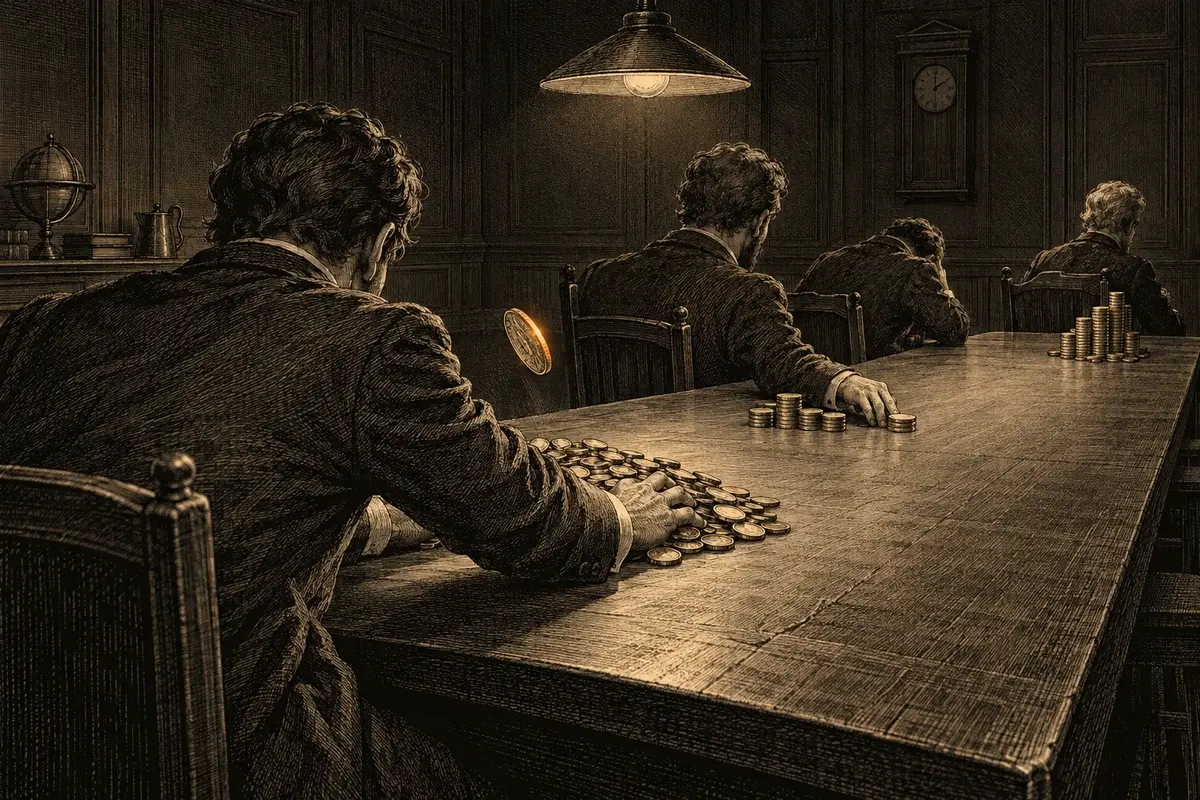
Без переваги визначення ставки – питання бюджету, а не зростання: ставка = скільки ви готові витратити за спін, виходячи з погодинного бюджету і темпу столу (сторінка про керування банкролом). Внесок Келлі для звичайного гравця – ясність відповіді: нуль. Усе, що ви ставите понад нуль, – це ціна гри, яку обираєте ви, а не оптимізує жодна формула.
Примітка про частковий Келлі і «керування грошима»
Betting a fixed percentage of the current bankroll is proportional staking: the stake rises after wins and falls after losses. Flat bettingстратегіяГра фіксованою ставкоюСтавити ту саму суму на кожному спіні. База, з якою порівнюють кожну прогресію.Читати повністю → instead keeps the cash stake fixed. Neither creates an edge on ordinary roulette. With infinitely divisible stakes and a fraction below 100%, proportional staking never reaches exactly zero in finitely many losses, but the balance can become arbitrarily small. Real table minimums can prevent further play much sooner. The growth-optimal fraction remains zero.
Формула
Запитання
Only when the actual probabilities, payouts and conditions give a credible positive advantage. Standard bets on an unbiased wheel have no such advantage.
Using half the calculated fraction reduces exposure to errors in the estimated edge. The familiar three-quarters-growth rule is an approximation for small advantages, not a universal identity. It does not protect against an edge that does not exist.
Ні. Келлі оптимізує зростання за наявності переваги. Керування банкролом контролює витрати за її відсутності.
Цікава математика
Спершу спробуйте розв’язати самі. Кожен розв’язок згорнуто; відкрийте його, коли будете готові.
Suppose a hypothetical bet on one number has a known 44% edge under standard payoutsгрошіВиплатаТе, що приносить виграшна ставка; записується як «X до 1» понад повернену ставку.Читати повністю → and independent spinsматематикаНезалежні спіниКожен спін має ті самі ймовірності незалежно від історії. Основа всіх розрахунків на цьому сайті.Читати повністю →. Kelly gives a 1.26% bankrollгрошіБанкролУся сума, відкладена на гру. Керування банкролом – це рішення про те, якою його часткою ризикувати в одній ставці та в одній сесії.Читати повністю → fraction. What if the same 44% edge came on one bet spread over five neighboring numbers?
Показати розв’язок
Відповідь Тоді Келлі радить 7,1% банкролу, і банкрол зростає майже вшестеро швидше: приблизно в 1,25 мільйона разів за 1 000 ставок проти приблизно 11,5 раза.
A straight upставкаПряма ставкаОдне число, виплата 35:1.Читати повністю → with a 44% edge wins with chance 0.04, since 36 × 0.04 = 1.44. Kelly’s stake is the edge divided by the odds: 0.44/35 = 1.26%. The typical growth per bet is 0.04 × ln(1 + 35 × 0.0126) + 0.96 × ln(1 − 0.0126) ≈ 0.00244, so 1,000 bets multiply the bankroll by about e^2.44 ≈ 11.5.
Spread one stake over five numbers and the bet wins with chance 0.20 and pays 36/5 for 1, that is 6.2 to 1: still a 44% edge, since 0.2 × 7.2 = 1.44. Kelly’s stake becomes 0.44/6.2 = 7.10%, and the growth per bet 0.01404, about 5.75 times as much. Over 1,000 bets that is e^14.04, about 1.25 million.
The edge is the same; the swings are smaller. A bet that wins one time in five has a larger growth-optimal fraction in this model, although losses can still reduce the bankroll severely. This comparison assumes the same known edge for both bets; actual predictions need independent evidence.
Assume two numbers are adjacent on the betting layoutобладнанняІгрове полеНадрукована сітка для ставок на столі. Також: стіл, сукно, полотно.Читати повністю → and each has a stable, known probabilityматематикаЙмовірністьМіра можливості результату: від 0 до 1 або від 0% до 100%. Одне число: 1/37 = 2,70%.Читати повністю → of 1 in 25 on independent spins. Compare a splitставкаСплітДва сусідні числа, виплата 17:1.Читати повністю → between them at 17 to 1 with equal straight-up stakes on the two numbers. How much does Kelly say, and how fast does the bankroll grow compared with one such pocketобладнанняКоміркаОдне з 37 пронумерованих відділень на роторі. Також: лунка, гніздо.Читати повністю →?
Показати розв’язок
Відповідь Різниці немає: 2,59% банкролу на спліт або 1,29% на кожне число. Типовий банкрол зростає приблизно в 155 разів за 1 000 спінів проти 11,5 раза з однією коміркою.
The split wins with probability 2/25 = 0.08 and pays 17 to 1, so it returns 18 × 0.08 = 1.44 per unitгрошіОдиницяБазова ставка, якою оперує система або гравець. Прогресії описують в одиницях, щоб вони підходили для будь-якого столу.Читати повністю → staked: an edge of 44%, the same as one biased pocket. Kelly’s stake is the edge divided by the odds: 0.44/17 = 2.59%.
Two straight-up bets of 1.29% each give exactly the same results. When either number comes up, one chipгрошіФішкаЖетон, що позначає певну суму; його кладуть на ігрове поле, щоб зробити ставку. Також: check.Читати повністю → wins 35 to 1 and the other is lost, a net of 34 × 1.29% = 44% of the bankroll, as the split pays; when neither does, both are lost.
The growth per spin is 0.00505, against 0.00244 for one pocket, so over 1,000 spins the typical bankroll grows e^5.046 ≈ 155 times rather than e^2.44 ≈ 11.5 times. The geometric growth factor is larger because the combined bet wins more often at the same 44% edge. It is a model result, not a guaranteed bankroll.
Трохи гумору
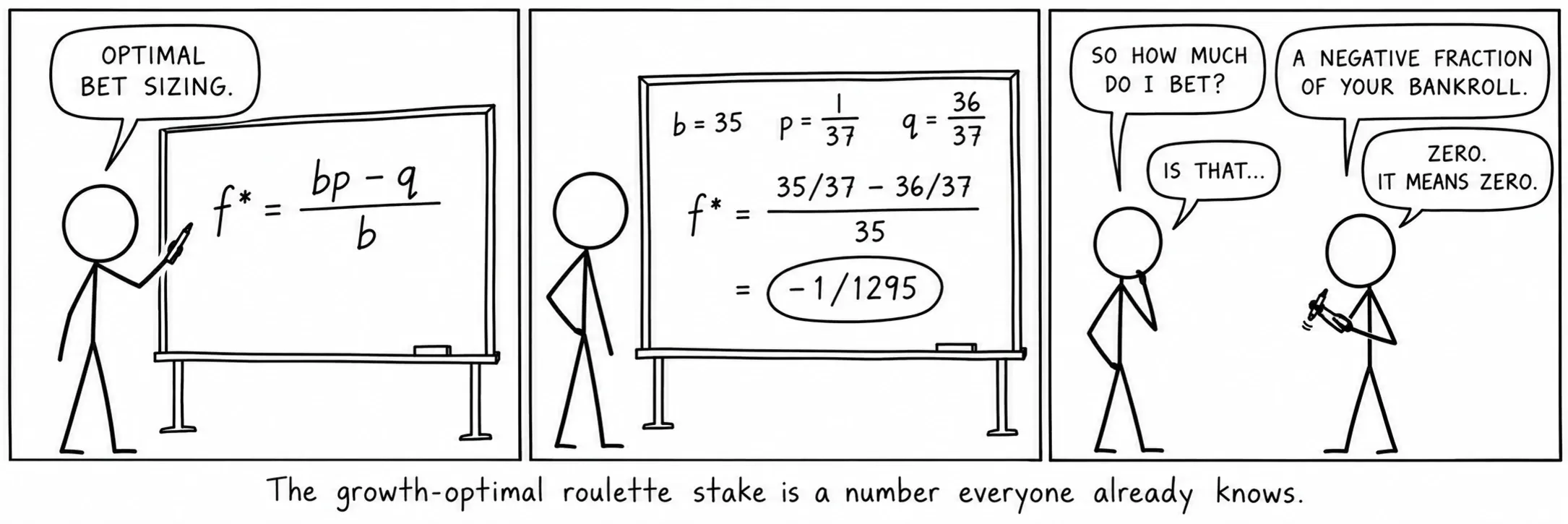
Ставка в рулетці, оптимальна для зростання, – число, яке всі вже знають.
Джерела
- Kelly, J. L. “A new interpretation of information rate.”
- Breiman, L. “Optimal gambling systems for favorable games.”
- Thorp, E. O. “Optimal gambling systems for favorable games.”
- Thorp, E. O. The Mathematics of Gambling.
- Epstein, R. A. The Theory of Gambling and Statistical Logic, 2nd ed.
- Taylor, D. G. Games, Gambling, and Probability: An Introduction to Mathematics, 2nd ed.
- Ethier, S. N. The Doctrine of Chances: Probabilistic Aspects of Gambling.
- Haghani, V. & Dewey, R. “Rational decision-making under uncertainty: observed betting patterns on a biased coin.”